Search for "social proof statistics" and you'll find the same numbers copied from list to list, often with no study behind them. This page is different in one simple way: every figure below links to the organization that published it, with the year and, where available, the sample size. We read each source ourselves. If we couldn't find a number at its source, we left it out.
New to the topic? Start with our explainer What is social proof?, then come back here for the evidence.
The key numbers at a glance
| Statistic | Source | Year |
|---|---|---|
| 97% of consumers read reviews for local businesses | BrightLocal | 2026 |
| 99.75% of online shoppers read reviews at least sometimes | PowerReviews | 2023 |
| A product with five reviews is 270% more likely to be bought than one with none | Spiegel Research Center | 2017 |
| Purchase likelihood usually peaks at ratings of 4.0–4.7 stars | Spiegel Research Center | 2017 |
| 47% won't use a business with fewer than 20 reviews | BrightLocal | 2026 |
| 83% trust recommendations from friends and family | Nielsen | 2015 |
| 19% of US cart abandoners (excluding "just browsing") didn't trust the site with their card | Baymard Institute | 2025 |
| "Guests in this room reuse towels" raised reuse to 49.3% vs 37.2% | Goldstein, Cialdini & Griskevicius | 2008 |
| Up to $51,744 per violation for knowingly using fake reviews (US) | FTC | 2024 |
How many people read reviews
97% of consumers read reviews for local businesses
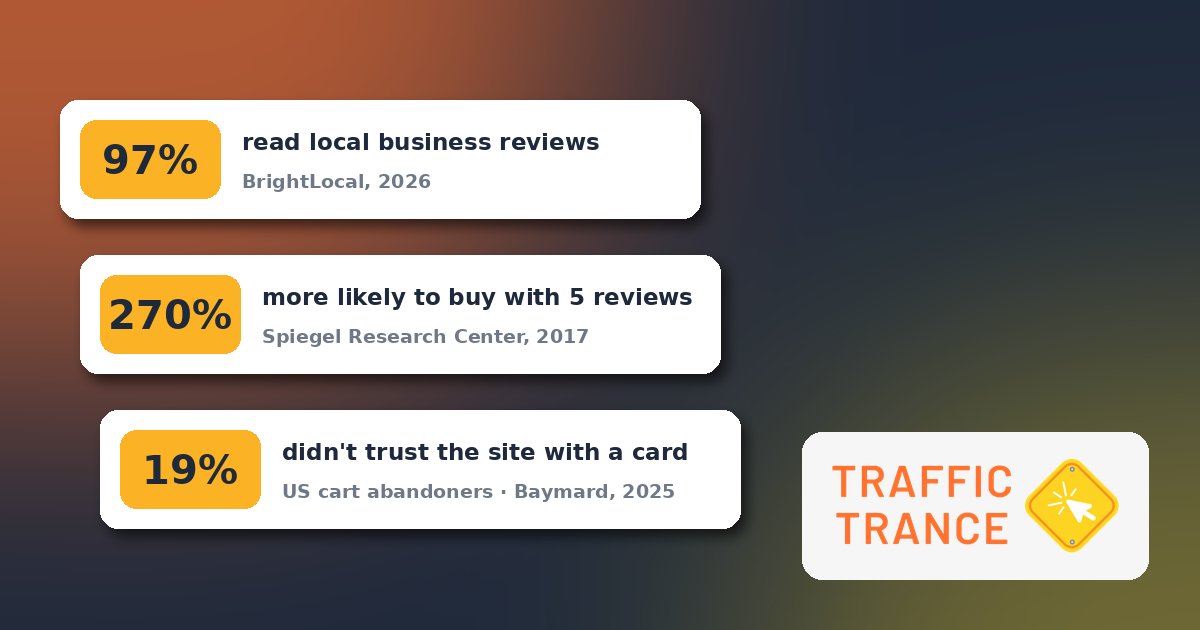
BrightLocal's Local Consumer Review Survey 2026 (1,002 US adults, published February 2026) found that 97% of consumers read online reviews for local businesses. More striking is the habit: 41% now "always" read reviews when browsing for a business, up from 29% a year earlier.
99.75% of online shoppers read product reviews at least sometimes
PowerReviews' The Ever-Growing Power of Reviews (2023), based on 8,153 US consumers, reports that 99.75% of online shoppers read reviews at least sometimes, and 91% do so always or regularly. In a later June 2025 PowerReviews survey of 21,279 consumers, 95% said they regularly read product reviews while shopping.
77% seek out sites that have reviews
In the same 2023 PowerReviews study, 77% of shoppers said they specifically seek out websites with ratings and reviews. Reviews don't only convert visitors; they influence which site people choose to visit in the first place.
How reviews change buying behavior
Five reviews: 270% higher purchase likelihood
Northwestern University's Medill Spiegel Research Center found that the purchase likelihood for a product with five reviews is 270% greater than for a product with no reviews. The benefit of extra reviews "begins diminishing rapidly after the first five." The practical lesson: getting a product from zero reviews to a handful matters more than taking a bestseller from 500 to 600.
Reviews matter more for expensive products
The same research found that displaying reviews raised the conversion rate by 190% for a lower-priced product and by 380% for a higher-priced one. The more a purchase costs, the more evidence people want before they commit.
"Verified buyer" badges add credibility
Spiegel also reports that identifying purchasers with verified buyer badges improves the odds of purchase by 15%. Labeling where proof comes from is a small change with a measurable effect.
Positive reviews pull, negative reviews push
According to BrightLocal (2026), 85% of people are more likely to use a business after reading positive reviews, while negative reviews put off 77%. And 93% of consumers say they have made a purchase after reading reviews.
Ratings, volume and recency: what makes proof believable
Perfect five-star ratings can hurt
Spiegel found that purchase likelihood typically peaks at average ratings between 4.0 and 4.7 stars and then decreases as ratings approach 5.0. A spotless score can look "too good to be true." Don't hide your critical reviews; answer them.
Expectations are rising fast
BrightLocal's 2026 survey shows that 31% of consumers will only use a business rated 4.5 stars or more, up from 17% the year before, and 68% require at least four stars (up from 55%).
Volume and freshness both count
Per BrightLocal (2026), 47% of consumers won't use a business with fewer than 20 reviews, and 74% only care about reviews written in the last three months. For products, PowerReviews (2023) found that 45% of consumers won't buy a product with no reviews at all; in its 2025 survey, only 43% said they would buy a product with zero ratings or reviews.
Who people trust
People trust people more than ads
Nielsen's Global Trust in Advertising report (2015) found that 83% of respondents completely or somewhat trust recommendations from friends and family, and 66% trust consumer opinions posted online. Branded websites came second at 70%. The data is from 2015, so treat it as a long-standing pattern rather than a 2026 measurement, but it explains why reviews and testimonials outperform polished ad copy.
AI assistants are a new source of recommendations
BrightLocal's 2026 analysis of AI use found that 45% of consumers have used AI tools for local business recommendations, up from 6% in 2025, and 88% of those AI users check whether the reviews it cites are legitimate or look up the source. Real, consistent reviews across platforms now feed both people and machines.
Trust at checkout
The Baymard Institute calculates an average documented cart abandonment rate of 70.22%, based on 50 studies (list last updated September 2025). Among US shoppers who abandoned for reasons other than "just browsing," 19% said they didn't trust the site with their credit card information. Trust signals near the payment step, such as security information, clear return policies and genuine customer feedback, address that specific doubt.
The psychology behind the numbers
The best-known field experiment on social proof comes from hotel bathrooms. In "A Room with a Viewpoint" (Journal of Consumer Research, 2008), Noah Goldstein, Robert Cialdini and Vladas Griskevicius tested towel-reuse cards. A card saying most guests reuse their towels achieved 44.1% reuse, compared with 35.1% for a standard environmental message. In a second experiment, a card saying most guests who had stayed in that same room reused towels reached 49.3%, versus 37.2% for the standard card.
The lesson for websites: proof works best when it comes from people like the visitor, in a situation like theirs. "Designers in Berlin use this template" beats "Thousands of users love us." For more on the mechanism, see our guide to social proof popups.
Fake social proof now carries real penalties
United States: the FTC rule on reviews and testimonials
On August 14, 2024, the US Federal Trade Commission announced a final rule banning fake reviews and testimonials. The rule, published in the Federal Register, took effect on October 21, 2024. It covers fake or AI-generated reviews, buying reviews conditioned on positive or negative sentiment, undisclosed insider reviews, review suppression and fake social media indicators such as bought followers. At the time, the FTC put the maximum civil penalty at $51,744 per violation.
United Kingdom: the DMCC Act
In the UK, the Digital Markets, Competition and Consumers Act 2024 bans fake reviews and concealed incentivised reviews for practices from 6 April 2025, according to the CMA's fake reviews guidance. Under the new regime, the CMA can fine companies up to 10% of global turnover for breaking consumer protection law.
The takeaway is simple: show only real activity, real reviews and real numbers.
What these statistics mean for your website
- Get every product or service past five reviews. The first few reviews do most of the work.
- Prioritize expensive pages. Proof matters most where the price, and the doubt, is highest.
- Keep proof fresh. Most consumers care about recent reviews, so show recent activity, not a testimonial from 2019.
- Make it specific and similar. Like the towel study, proof from people in the visitor's situation works best.
- Put trust signals at the moment of doubt. Near the price, the signup form and the payment step.
- Never fake it. It's deceptive, and in the US and UK it can now be fined.
Need ideas for what to show? Our list of 27 social proof examples covers reviews, live activity, counters and badges.
How to cite social proof statistics responsibly
Many numbers circulating online have no traceable study behind them. Before you put a statistic in a pitch deck or on your website, check that you can find the original publisher, the year, the sample and the exact wording. Survey answers ("I read reviews") measure what people say, while studies like Spiegel's measure what people do; both are useful, but they're not the same thing. And if a number is ten years old, say so.
Frequently asked questions
What is the most important social proof statistic?
For most websites, it's Spiegel's finding that a product with five reviews is 270% more likely to be bought than one with none. It tells you where to start: get rid of "no reviews yet."
How many reviews does a business need?
Spiegel's data shows the biggest jump comes with the first five reviews, but consumer expectations are higher: BrightLocal (2026) found that 47% won't use a business with fewer than 20 reviews. Aim for five quickly, then keep a steady flow of recent ones.
Are these statistics up to date?
The BrightLocal figures are from 2026, PowerReviews from 2023 and 2025, and Baymard's list was updated in 2025. The Spiegel (2017), Nielsen (2015) and towel (2008) studies are older but still widely used; their year is shown next to each number.
Is it legal to show recent sales or signup popups?
Yes, as long as they reflect real activity. What the FTC rule and the UK DMCC Act target is fake or misleading proof.
How can I add real social proof to my site for free?
Traffic Trance is a free tool with one free plan: recent activity notifications, live visitor counts, review highlights and counters, installed with one line of code. Create your free account and launch your first notification in minutes.
Turn the statistics into results
Statistics only describe other people's websites. The number that matters is your own conversion rate before and after you add honest proof. Pick one page, add one real signal, and measure it for a few weeks. Start free with Traffic Trance and show visitors what real customers are doing right now.