Imagine two restaurants next to each other on a street you've never visited. One is full, with people waiting at the door. The other is empty. Most of us pick the full one without thinking twice, even though we know nothing about either kitchen. That small decision is social proof at work, and it shapes what people click, buy and sign up for on the web every day.
This guide explains what social proof is, why it is so persuasive, and the nine types you can use on a website, each with a real example of how well-known sites already do it.
What is social proof?
Social proof is the tendency to look at what other people do, or approve of, to decide what we should do, especially when we are unsure. In marketing, it means showing visitors evidence that real people already trust, use or recommend your product.
The term was popularized by psychologist Robert Cialdini in his book Influence: The Psychology of Persuasion (first published in 1984), where social proof is one of the core principles of persuasion. Cialdini noted that it is strongest under two conditions:
- Uncertainty: when we don't know the right answer, we copy others.
- Similarity: we are influenced most by people who seem like us.
Earlier research points the same way. In Solomon Asch's well-known conformity experiments in the 1950s, many participants went along with a group's clearly wrong answer rather than trust their own eyes. A website visitor is in an even weaker position: they can't see your shop, touch your product or ask a friend in the room. Social proof fills that gap.
Why social proof matters on a website
Online, every visitor arrives with doubt: Is this legit? Will it work for me? Is anyone else using it? Social proof answers those questions faster than any feature list, because it comes from other people rather than from you. Used well, it:
- lowers the perceived risk of buying or signing up;
- helps visitors choose between options ("most popular");
- makes a new or small business look active and real;
- gives hesitant visitors a reason to act now instead of "later".
The 9 types of social proof (with real examples)
1. Customer reviews and star ratings
The most familiar type. Amazon puts the average star rating and number of ratings right next to every product title, and lets shoppers filter by rating. Ratings work because they combine two signals at once: quality (the score) and popularity (the count).
How to use it: show the rating near the price or the buy button, not only at the bottom of the page. Keep the negative reviews visible too; a 4.7 with honest criticism is more believable than a perfect 5.0.
2. Testimonials and case studies
Where a review is short, a testimonial or case study tells a story: the problem, the solution and the result, in the customer's own words. Most B2B software sites have a "Customers" page full of these stories, often with a name, photo, job title and company.
How to use it: place a single, specific testimonial beside the objection it answers. "Setup took me ten minutes" belongs next to your signup form, not on a separate page nobody visits.
3. Crowd numbers ("wisdom of the crowd")
Big numbers signal that many people have already made the same choice. Spotify shows how many monthly listeners an artist has. GitHub shows how many stars a code repository has collected. Newsletters often say how many subscribers they have.
How to use it: use a number only when it is real and impressive in context. "Join 1,200 local bakers" can persuade more than a vague "thousands of users", because it is specific and relevant.
4. Real-time activity
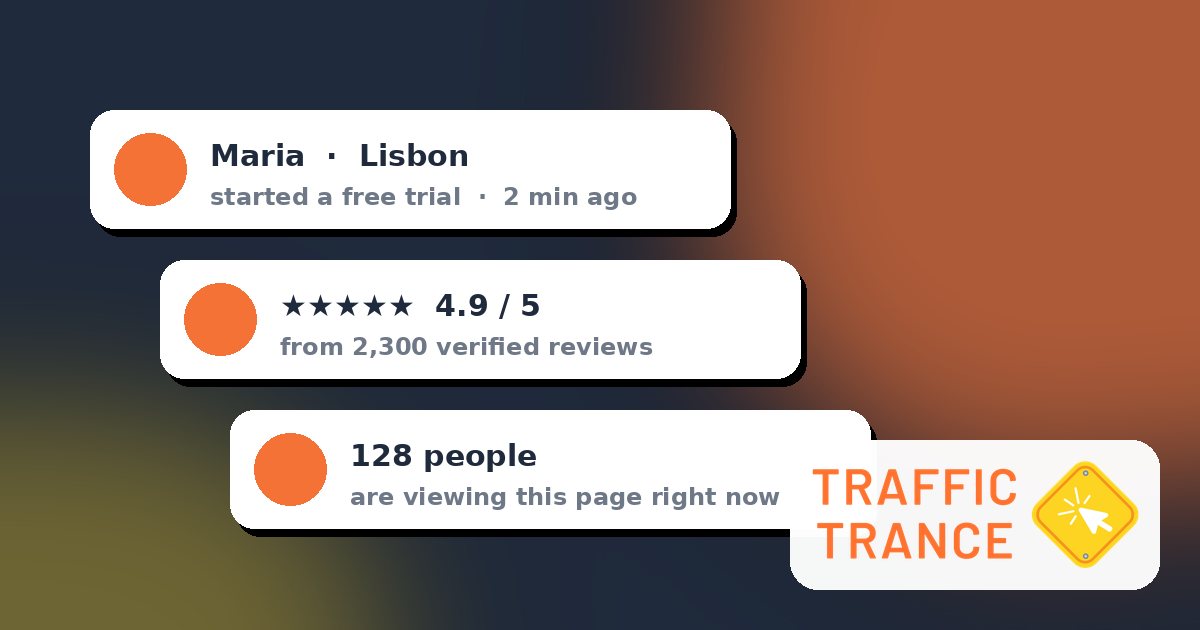
Live signals show that people are acting right now. Booking sites such as Booking.com have long shown messages about how many people are viewing a property or how recently it was booked. Ecommerce stores show "Someone in Austin just bought this" notifications.
How to use it: this is what social proof popups are built for. Our guide to social proof popups covers the types, placement and timing in detail. Only show genuine activity; regulators such as the UK's Competition and Markets Authority have acted against misleading pressure-selling claims on hotel booking sites.
5. Expert social proof
An endorsement from a credible expert in your field: a dentist recommending a toothbrush, a well-known developer recommending a coding tool, a chef using a brand of knife. Experts reduce doubt because the visitor assumes they know what they're talking about.
How to use it: quote the expert with their real name and credentials, and make sure you have permission. One respected voice in your niche beats a generic celebrity.
6. Celebrity and influencer endorsements
When a famous person or creator uses a product, their audience pays attention. Sports brands have built their marketing on athletes for decades; today, smaller brands work with creators who have loyal audiences in a specific niche.
How to use it: choose people your customers actually follow and trust. In the US, the FTC's Endorsement Guides require endorsers to clearly disclose paid relationships, and similar rules exist in many countries.
7. Certifications, badges and awards
Third-party badges borrow trust from an independent authority. Airbnb marks experienced, highly rated hosts as Superhosts. Etsy gives Star Seller badges. Tripadvisor hands out Travelers' Choice awards that hotels and restaurants display proudly on their own websites.
How to use it: show badges that your visitors recognize and that relate to their worries: security seals near checkout, industry certifications near your service description, awards near your headline.
8. Client logos and media mentions
"Trusted by" logo strips and "As seen in" press bars are a staple of SaaS and agency homepages. They tell visitors that recognizable companies or publications have already vetted you.
How to use it: only show logos of real clients or real coverage, ideally with a link to the article or case study. Five relevant logos beat twenty random ones.
9. User-generated content and friends
Photos, videos and posts that real customers create are some of the most convincing proof, because they are clearly not made by the brand. Many fashion and beauty stores show customer photos on product pages, and Facebook has long shown when your friends like a page. Proof from people we know is the most powerful of all.
How to use it: invite customers to share photos with a hashtag, ask permission before reusing them, and add a short "customer photos" section to your best-selling product pages.
Where to put social proof on your website
Social proof works best at the moment of doubt. A simple map:
- Homepage: client logos, a crowd number, one strong testimonial.
- Product pages: ratings next to the title, reviews and customer photos below.
- Pricing or signup page: a short testimonial about value, a live signup notification.
- Checkout: security badges and a reassuring review about delivery or support.
- Blog and landing pages: subscriber counts and recent signups next to email forms.
Social proof mistakes to avoid
- Faking it. Invented reviews, inflated counters and fake "just bought" messages destroy trust once discovered, and they can be illegal. In 2024 the FTC finalized a rule banning fake reviews and testimonials in the US.
- Negative social proof. "Only 2% of visitors sign up" or "most people forget to recycle" tells people that the bad behavior is normal. Cialdini warned about exactly this mistake.
- Weak numbers. "3 people bought this" can hurt more than help. If your numbers are small, use testimonials or recent activity instead of totals.
- Proof in the wrong place. A brilliant review hidden at the bottom of the page does nothing for the visitor hesitating at the top.
- Overload. Ten popups and five badges at once look desperate. Our FOMO marketing tactics guide explains how to add urgency without annoying people.
How to add social proof to your site today
- Collect what you already have: reviews, emails from happy customers, signup totals, press mentions.
- Find your doubt pages: the pages with traffic but low conversions, usually pricing, product and signup.
- Add one type of proof per page that answers that page's main objection.
- Add live notifications for recent signups or sales, with a small, non-blocking popup.
- Measure your conversion rate for two to four weeks before and after, and keep what works.
Frequently asked questions
What is social proof in simple words?
It is the idea that people follow other people. When visitors see that others already bought, liked or recommended something, they feel safer doing the same.
What is an example of social proof?
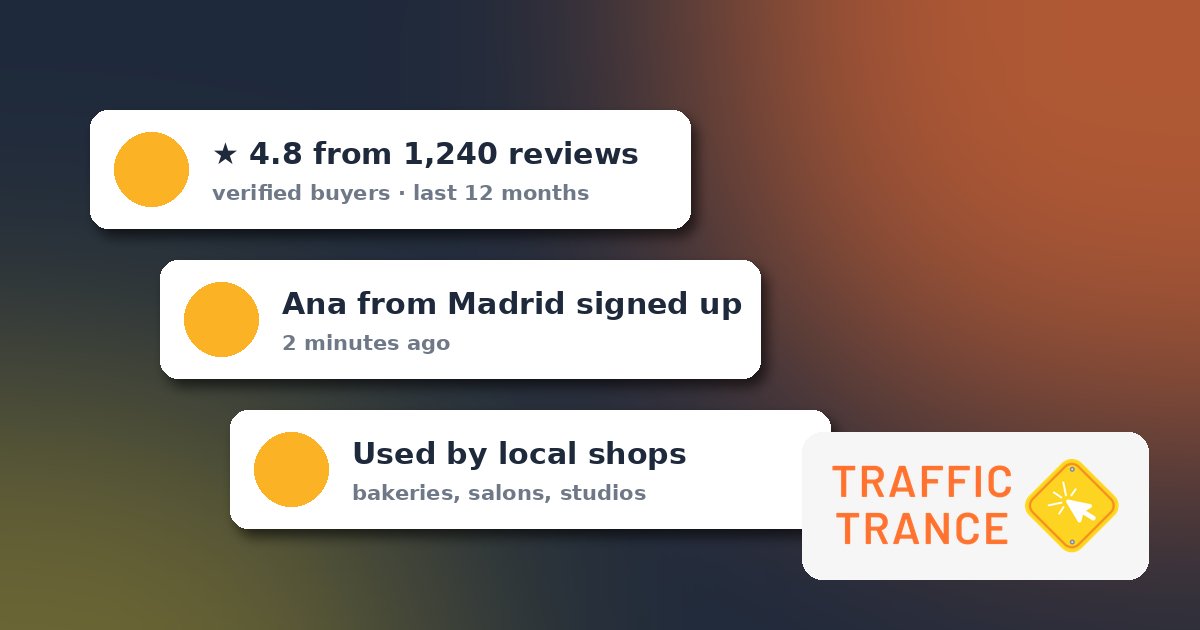
Star ratings on a product page, a "Trusted by" logo strip, a testimonial with a customer's photo, or a notification such as "Ana from Madrid just signed up" are all common examples.
Is social proof ethical?
Yes, as long as it is true. Showing real reviews and real activity helps visitors decide. Inventing it is deceptive, and in many countries it breaks consumer protection law.
How can I add social proof notifications for free?
Traffic Trance is a free tool for social proof popups: recent activity, live visitor counts, reviews, counters and more, installed with one line of code. Create your free account and launch your first notification in a few minutes.
Start with one honest signal
You don't need all nine types at once. Pick the page where visitors hesitate most, add the one piece of proof that answers their doubt, and measure what happens. Real evidence, shown at the right moment, is still one of the simplest ways to turn visitors into customers. Start free with Traffic Trance.