"1,240 people bought this today." "Sara from Lyon just signed up." "Most guests in this room reuse their towels." Messages like these are everywhere online, and they work for reasons psychologists have studied for more than seventy years. Understanding those reasons is the difference between social proof that persuades and social proof that gets ignored, or even backfires.
This article explains the psychology of social proof using the original research, not recycled marketing claims. If you need a quick definition first, read What is social proof? and come back.
What social proof means in psychology
Robert Cialdini made the term famous in his book Influence (1984). His definition is simple: social proof is the tendency to decide what is correct by finding out what other people think is correct. Cialdini stresses two conditions that make it strongest:
- Uncertainty. When we don't know what to do, other people's behavior is the cheapest evidence available.
- Similarity. We follow people who resemble us far more than people who don't.
Psychologists also distinguish two motives behind following others, a distinction published by Morton Deutsch and Harold Gerard in 1955:
- Informational social influence: we copy others because we think they know something we don't. "If so many people chose this plan, it's probably the right one."
- Normative social influence: we copy others because we want to fit in and be accepted. "People like me do this."
A recent-purchase popup mostly triggers the first motive: it gives a hesitant visitor information. A message such as "Join 3,000 designers who use this template" leans on the second: it tells visitors what their group does.
The research behind social proof
Asch's line experiments: even obvious answers bend
In the early 1950s, Solomon Asch asked people to say which of three lines matched a reference line. The task was easy: working alone, people made mistakes less than 1% of the time. But when the real participant answered after a group of confederates who all gave the same wrong answer, participants went along with the wrong majority in 36.8% of the critical trials. About a quarter of participants never conformed at all.
Two details matter for marketers. First, size: with one opponent, errors were 3.6%; with two, 13.6%; with three, 31.8%; larger majorities added little. Second, a single ally changed everything: when one other person gave the correct answer, participants conformed only about one-fourth as often. Asch summarized these results for a general audience in Scientific American in 1955.
The street corner study: crowds draw crowds
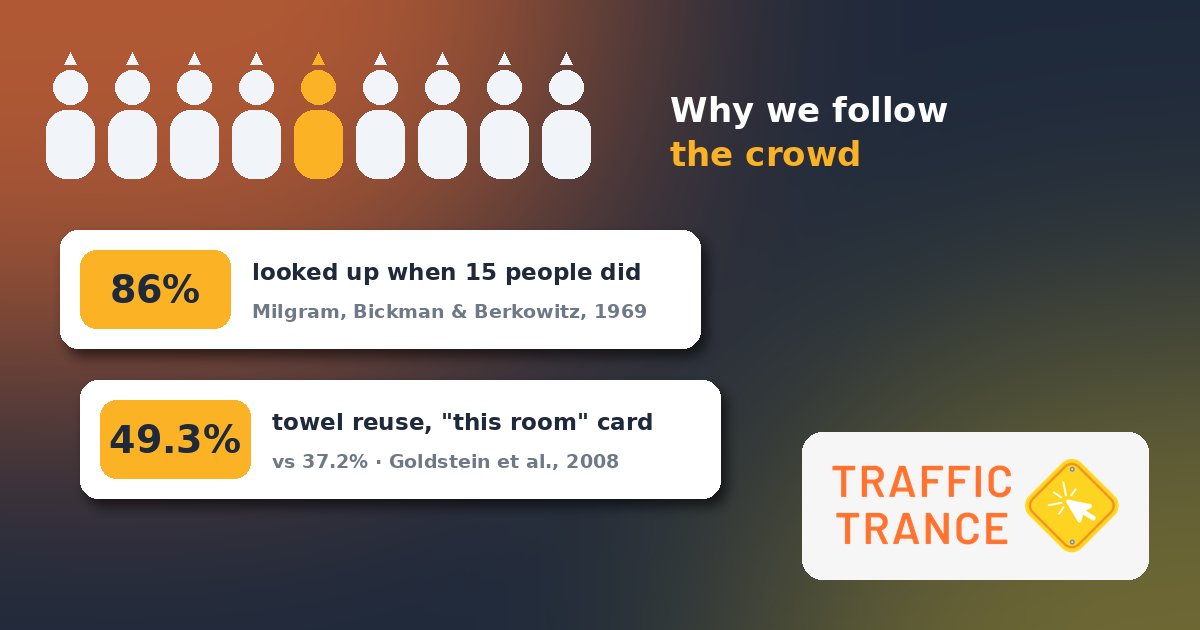
In 1968, Stanley Milgram, Leonard Bickman and Lawrence Berkowitz placed groups of 1 to 15 people on a busy New York sidewalk, all staring up at a sixth-floor window where nothing was happening. They filmed 1,424 passersby. When one person looked up, 4% of passersby stopped and 42% looked up too. With a group of 15, 40% stopped and 86% looked up. The only thing that changed was how many people were already doing it.
The hotel towel study: "people like you" beats "save the planet"
Noah Goldstein, Robert Cialdini and Vladas Griskevicius tested the cards hotels use to ask guests to reuse towels (published in 2008). A card saying most guests reuse their towels led to a 44.1% reuse rate, compared with 35.1% for the standard environmental message. A card saying most guests who had stayed in this room reused their towels reached 49.3%, against 37.2% for the standard message in that experiment. The closer the reference group, the stronger the pull.
MusicLab: popularity changes what becomes popular
In a 2006 study in Science, Matthew Salganik, Peter Dodds and Duncan Watts built an online "music market" of 48 unknown songs with 14,341 participants. Some people saw only song names; others also saw how many times each song had been downloaded, in one of eight separate "worlds." Showing download counts made success both more unequal and less predictable. Quality still mattered (the best songs rarely did poorly and the worst rarely did well), but anything else was possible.
Upvotes: one early vote snowballs
Lev Muchnik, Sinan Aral and Sean Taylor ran a randomized experiment on a social news site and published it in Science in 2013. Comments that randomly received one extra upvote at creation were 32% more likely to get a positive rating from the next viewer, and their final scores ended up 25% higher on average. Random downvotes, by contrast, were largely corrected by other users. People herd on positive signals more than negative ones.
The key studies at a glance
| Study | Year | What it showed |
|---|---|---|
| Asch, line judgments | 1951–1956 | Wrong answers in 36.8% of critical trials under a unanimous majority; one ally cut conformity to about a quarter |
| Milgram, Bickman & Berkowitz, street corner | 1969 | 15 people looking up: 86% of passersby looked up, 40% stopped |
| Goldstein, Cialdini & Griskevicius, hotel towels | 2008 | "Guests in this room" message: 49.3% reuse vs 37.2% |
| Salganik, Dodds & Watts, MusicLab | 2006 | Visible download counts made hits bigger and less predictable |
| Muchnik, Aral & Taylor, upvotes | 2013 | One early upvote raised final ratings by 25% on average |
Why "others bought this" works: five mechanisms
- It reduces uncertainty. A first-time visitor can't test your product before buying. Evidence that others did is the next best thing. This is informational influence at work.
- It lowers perceived risk. If many people made the same choice and nothing went wrong, the choice feels safer. That's why proof matters most at checkout and signup, where risk feels highest.
- It signals similarity. The towel study shows that "people like you" or "people in your situation" carries more weight than a generic crowd. A notification from the same city or industry is more persuasive than an anonymous number.
- It sets a norm. When you show what most people do, you quietly tell visitors what is normal. Normal choices need less justification.
- It compounds. MusicLab and the upvote experiment show that early signals attract more of the same. Early reviews and first signups are disproportionately valuable.
When social proof backfires
The same psychology can work against you. In a study at Petrified Forest National Park published in 2006, Cialdini and colleagues found that a sign stressing that "many past visitors have removed the petrified wood" led to 7.92% theft, while a sign simply asking visitors not to remove wood led to 1.67%. Telling people a bad behavior is common makes it feel normal.
A 2007 study by Wesley Schultz and colleagues found a similar trap. Households told they used less energy than their neighbors increased their use toward the average, a "boomerang effect." Adding a smiley face (approval) stopped it. Lessons for websites:
- Don't advertise what most people do wrong ("80% of visitors leave without buying"). Show what the majority does right.
- Pair numbers with approval when you can: a short positive review next to a count works better than a count alone.
- Small or stale numbers can signal unpopularity. "2 people bought this last month" may hurt more than showing nothing.
- Fake proof is a legal risk as well as a psychological one. See our social proof statistics for the FTC and UK rules on fake reviews.
How to apply social proof psychology on your website
- Place proof where uncertainty peaks: pricing pages, signup forms, checkout and product pages with many options.
- Make it specific and similar: "A designer in Madrid just started a free trial" beats "Thousands of happy users."
- Use a few credible signals, not dozens: Asch's data and the street corner study suggest that a handful of visible others does most of the work.
- Get early proof fast: collect your first reviews and testimonials early, because early signals snowball.
- Show what the majority does right, and add approval (stars, short quotes) where possible.
- Keep it true and recent: real events only, with honest timestamps.
- Measure: compare conversion before and after on one page before rolling out site-wide.
Need inspiration? Browse our 27 social proof examples, our guide to social proof popups and these ethical FOMO tactics.
Frequently asked questions
What is social proof in psychology?
It's the tendency to look at what others do to decide what is correct, especially when we're uncertain and when those others resemble us. Robert Cialdini popularized the term in Influence (1984).
What is the difference between informational and normative social influence?
Informational influence means following others because you think they know better. Normative influence means following others to fit in. Deutsch and Gerard described the distinction in 1955.
Is using social proof manipulative?
Not when it's true. Real reviews and real activity help people make decisions with better information. Fake counts and invented reviews are deceptive and, in many countries, illegal.
Does social proof work on everyone?
No. In Asch's experiments about a quarter of participants never conformed. Social proof is strongest for uncertain, first-time visitors and weakest for confident experts.
How can I add social proof to my site for free?
Traffic Trance is a free tool with one free plan: recent activity notifications, live visitor counts, review highlights and counters, installed with one line of code. Create your free account and launch your first notification in minutes.
Put the psychology to work
Seventy years of research point the same way: people look to others when they're unsure, and they look hardest at people like themselves. Give your visitors honest, specific and recent evidence of what customers like them are doing, at the moment they hesitate. Start free with Traffic Trance and show real social proof on your site today.